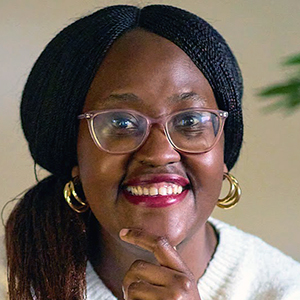
Njeri Gachathi
Early Childhood and Childhood General Education '19
Play is not a break from learning. Play is learning.
Njeri Gachathi is a first-grade head teacher at Bank Street School for Children and a 2019 graduate of the Early Childhood and Childhood General Education program at Bank Street Graduate School of Education. Originally from Kenya, she spent three years teaching English as a second language in Vietnam. There, a colleague first told her about Bank Street’s graduate programs, and she moved to New York to enroll.
What drew her to the Graduate School was its extensive fieldwork, paired with weekly conference groups where students meet with peers and their faculty advisor.
“No other program I looked at offered anything like it, and it turned out to be one of the most important parts of my training,” she said.
Before her final student teaching placement, her advisor, Sal Vascellaro, sensed a hesitancy in her that she hadn’t said out loud. After a follow-up conversation, he guided her toward a placement at a school he thought might be a better fit: Manhattan Country School. She stayed for six years, growing from student teacher to assistant teacher to head teacher before joining the School for Children staff.
“What stays with me most is that Sal paid attention to my body language, to what I hadn’t yet found words for. That’s exactly what a good teacher does,” she said. “It’s not lost on me that the lesson at the center of my own graduate training was really the same one I now try to practice with children every day.”
This year, Njeri went back to Kenya, where she led The Case for Play, a training workshop she developed for teachers spanning several Kenyan curriculum frameworks. The initiative reached more than 120 teachers across 14 schools in Nairobi and was featured on Citizen TV, Kenya’s largest national broadcaster.
“Play is not a break from learning. Play is learning,” she said. “It isn’t just something that happens on the playground, and then you come back to do real work in the classroom.”
She built the workshop the way she plans lessons for her Bank Street students: start with a learning goal, then find a hands-on way in before introducing an abstract concept. During the sessions, teachers took a curriculum objective and turned it into something children could touch, build, and move through, using popsicle sticks, pipe cleaners, and other simple, low-cost materials.
“You can use things in nature: leaves, rocks, sticks,” she said. “Go collect 10 sticks, 10 leaves, and that’s multiplication, multiples of 10. It’s very affordable.”
In Nairobi, Njeri also approached the workshop as an exchange rather than a one-way lesson, a stance rooted in the idea of funds of knowledge, which she first learned at Bank Street.
“Yes, I’m trained at Bank Street, and that training is beautiful and valuable, but it is also a particular training,” she said. “The teachers I worked with brought their own funds of knowledge, and I saw it as my role to honor and learn from that as much as I was there to lead and facilitate the workshop.”
Back in her first-grade classroom at the School for Children, Njeri is surrounded by the Bank Street community that shaped her. She has also guest-lectured at the Graduate School in a former professor’s class, and she continues to sharpen her practice through the Teaching Kindergarten Conference and Continuing Professional Studies courses.
“When I think about the mentors who have most shaped, guided, and inspired me throughout my education journey, they are almost entirely Bank Street graduates or fellow faculty at the School for Children,” she said. “It’s a whole ecosystem, not just a degree program, and that’s what makes it feel like a genuine, ongoing community rather than something I graduated out of.”