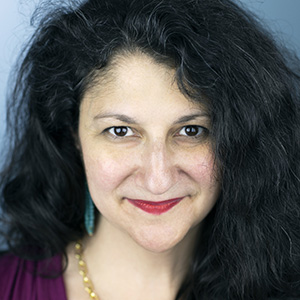
Rebecca Glazer
Teaching Literacy and Childhood General Education '06
People who truly know education policy and theory know Bank Street. I chose this school for its use of seminars and in-depth writing experiences, and it gave me a rocket booster to head in the right direction.
Rebecca Glazer completed her Master of Science in Education with a focus in Childhood General Education and Literacy at Bank Street Graduate School of Education in 2006. Driven by a commitment to equity, she integrated her academic training directly into her work as a classroom teacher, reading interventionist, and literacy coach across New York City and in Title 1 schools, which serve high-density populations of low-income families. Her experiences at Bank Street served as a creative launchpad for her current career as an entrepreneur, writer, and film producer. Today, she operates 917 Studios LLC, a multidisciplinary, collaborative space that fuses the art of storytelling in all modalities with the science of human flourishing. Rebecca is currently pursuing a second master’s degree in Happiness Studies, an interdisciplinary approach to the science behind human flourishing, at Centenary University.
What were you doing before you turned your focus toward literacy?
I hold a BA in Psychology with a minor in Business Foundations from the University of Texas at Austin. Although I initially planned to become a constitutional law professor, I had an interest in literacy learning and have always been a writer. I assisted with research in my Psychology of Reading class, and after graduation, I started volunteering in a literacy program in California. I realized that I could combine my love of teaching with my deep commitment to literacy.
Why did you choose Bank Street for your master’s degree?
Attending school in Manhattan was pivotal, and I loved having the city as the best lesson plan of all. I had been accepted to programs at Columbia University and New York University, but Bank Street stood out as a place that would catapult me toward higher purposes: equity in education and literacy for all. I knew the program would give me the space to synthesize, process, debate, and embed all of this information into my teaching pedagogy.
What parts of your program stand out the most?
Bank Street, inspired by John Dewey and founded by Lucy Sprague Mitchell, gave a space for educators to come together and see how teaching children within a true child development umbrella is the key to successful education. The close-knit, seminar classes allowed for psychological safety to promote our ideas around education, equity, and policy. I made long-lasting friendships and a network of colleagues because there’s something about bonding over advocating for education for all that brings people together.
My favorite courses—Children’s Literature, Block Building, and Mathematics for Teachers— gave me the ability to teach everything through literacy. We experimented firsthand with kinesthetic experiences and play. I remember incorporating literacy into block building and seeing the first-graders in my cooperating classroom build and label a block replica of Tokyo. It proved that the business of educating our children has to be done with their specific stages of development in mind.
Where did your career lead after graduation?
For my final project, I researched and wrote a children’s book to fill a gap in diverse and inclusive literature. That project furthered my love of writing and mission to add my voice to the world.
Immediately after graduating, I worked as a second-grade teacher in New York City and in the surrounding areas as a reading interventionist, and also as a literacy coach and teacher trainer in Title 1 schools. During that time, I discovered a love for speaking to large crowds to share my spark and joy around writing. I’ve never left behind my direct experiences in education, as they dynamically elevate my current writing, networking, and filmmaking endeavors, as well as my commitment to continue advocating for literacy for all.
How did your Bank Street training impact individual students?
I once taught a classroom writing unit on filmmaking where everyone had a specific job in producing a short film. Using lenses of child development and community, I included plenty of non-traditional writing tasks. A student with dyslexia thrived because he could edit our shared storytelling without relying solely on traditional pen-to-paper production. What I learned at Bank Street is so deeply embedded in me that I didn’t even realize how impactful these best practices were until after the fact.
Tell us about your current work and your studio.
Today, I run 917 Studios LLC, which is in its evolution into a flourishing space where creatives come together to network, create teams, promote learning, and elevate their overall happiness. I write slice of life dramatic and dramedy film screenplays, scripts for television, and scripts for children’s literacy around happiness, which I am currently circulating into the world. I also am in the nascent stages of curating creative retreats, and I’m collaborating with a former colleague to create a writing curriculum for teachers. Through the studio, I also wrote and produced the short film A Life Well Lived, which screened at major festivals, and my feature screenplay Doro o Kaburu (Stuck in the Mud) advanced as a second-rounder at the Austin Film Festival. I’ve written and co-written over 20 feature screenplays and television pilots, many of which have placed and won in screenwriting contests around the world. My film, Left in Pieces, is in the very early pre-production stages. It’s a film about love and loss in Paris.
How does your Bank Street foundation continue to influence you today?
People who truly know education policy and theory know Bank Street. I chose this school for its use of seminars and in-depth writing experiences, and it gave me a rocket booster to head in the right direction. I’ve hardly stayed on a traditional career path, but it was a necessary step in my journey. My in-depth knowledge of education and literacy learning affects me daily as a writer, producer, public speaker, literacy advocate, educator, and most importantly, as a parent.