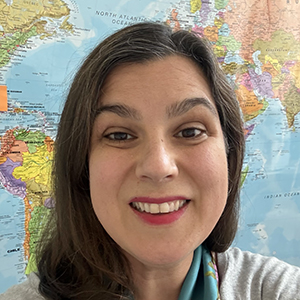
Marylen Townley Massen
Teaching Literacy and Childhood General Education '10
The child is your manual. Knowing who they are — their cognition, temperament, challenges, traumas, what they face medically. Knowing all of it helps me make the right decisions as I work to advance their literacy.
Marylen Townley Massen came to literacy through the performing arts, and it shows. A trained actor with a background in New York City theater, she brought to her earliest work with children something most education programs spend years trying to instill: the instinct to meet people where they are, read a room, and connect. When a school district hired her in her early 20s to tutor a child with autism, specifically because the family wanted someone who could weave theater games and social skills into reading instruction, she discovered a calling.
Marylen said, “I learned really quickly how much I loved that work. It was really gratifying, and I felt like I had a real talent for it and it was something I needed to pursue.”
What followed was a period of intensive immersion. She worked in commercial tutoring and went to work at a literacy clinic where she watched children who had struggled for years learn to read within weeks. She then spent a year living in Gallup, New Mexico, working on and off the Navajo and Zuni Nations training classroom teachers for Lindamood-Bell. The transformation she witnessed in those early students—on their faces, in their spirit—was, she says, life-changing.
She also recognized what she was missing: an understanding of the whole child, not just the programs. She set her sights on Bank Street, and it was the only place she applied.
Marylen said, “I came to Bank Street because I knew I would learn more about child development. I had seen that children’s individual social and cultural experiences impacted their learning lives. I needed to know about the whole person to be a good teacher.”
She completed the dual Teaching Literacy and Childhood General Education program, forming relationships with her instructors that carried her through and an intellectual framework that has shaped everything since.
“The warmth, the tone, the obvious mission to understand children as full humans and having instructors who embodied all this—that was my favorite thing,” Marylen said. “This respect for children permeates everything.”
After graduating, she ran a literacy program out of Thurgood Marshall Academy Middle School through the Northside Center for Child Development in Harlem. In 2012, she opened Read and Write NYC in Cobble Hill, Brooklyn. Today, her practice is a warm, collaborative space she shares with another Bank Street-trained reading specialist and an occupational therapist. They pool their knowledge, conference on cases, and share referrals.
Her clinic is drawn to students across school districts whom others have struggled to reach: children with autism, dyslexia, intellectual disabilities, or complex medical histories; students who are demand-avoidant; kids who’ve cycled through programs without finding their footing. Much of the work extends beyond the session itself, including training parents, attending IEP meetings, and collaborating with schools.
For Marylen, the child is always at the center.
“The child is your manual. Knowing who they are—their cognition, temperament, challenges, traumas, what they face medically. Knowing all of it helps me make the right decisions as I work to advance their literacy.”
Bank Street shaped how Marylen thinks about children, and she recognizes that way of seeing the moment she meets another Bank Street-trained educator. She seeks them out as collaborators, her own children have had Bank Street teachers, and she stays connected as a faculty member, teaching a course at the graduate school.
Ask her why reading and literacy matter, and her answer has nothing to do with academic test scores.
“When you read a book, you are sitting down with an author and making friends with that person. If you’re a kid and you’re not like everybody else you see around you, in a book you might meet someone who represents you. Books transport us to a wider community when we may not have—to the community that we need in our actual life. That is why I think reading is important.”
To follow Marylen’s professional thinking, join her on Instagram at @readandwritenyc.