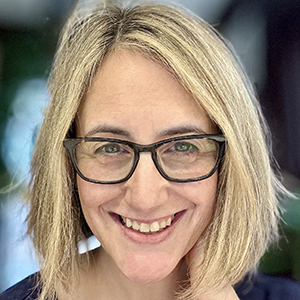
Melissa Birnbaum
Leadership for Educational Change '19
I thought I’d have this linear path to becoming an assistant principal and then a principal. But then I stopped to reflect on that and consider what I really wanted. I didn’t know I would wind up in the classroom!—the answer just sort of presented itself, and now I’m the happiest I’ve ever been.
For Melissa, the path to educational leadership was never a straight line as she sought ways to merge her identity as a visual artist with her commitment to finding a leadership role in progressive education.
While leading a large interdisciplinary teaching team at City-As-School High School, Melissa was nominated by her principal for Bank Street’s educational leadership cohort. Because she often found that she wasn’t teaching art but rather “doing so many other things” that required the skills she had previously developed in the corporate world, she saw this moment as an opportunity to bridge the gap between her prior work experience, her passion for art education, and her desire to become a leader.
“Okay, this is going to be something that will help me prove my vision and see what happens,” she said.
Melissa entered the Leadership for Educational Change Program (now the Progressive Leadership Program) and immediately found a home in the Bank Street community. Her Bank Street experience was defined by moments of profound pedagogical shift. In her Leadership of Curriculum and Instruction course with Ali Snell, Melissa experienced firsthand the power of intentional community-building.
“That class was so memorable because it completely de-centered my perspective,” Melissa said. “it made me want to return to the classroom immediately.”
Melissa recalls how Ali began every session by revisiting norms the class devised together.
“It reminded us that we were establishing a community together. This made us brave enough to take risks that we might not have otherwise taken.”
This focus on the “hidden curriculum” led Melissa to a humbling realization about her own past teaching: by reflecting on diverse learning styles, she recognized where her previous work might have left certain students feeling unseen. The experience was so transformative that she found herself yearning to return to the heart of the work. After that, whenever her colleagues asked about her leadership program, she would say, “I think I need to be back in the classroom a little bit more. I want to be with the kids! That’s where it’s at.”
After graduating from Bank Street in 2019, Melissa’s journey took her into the world of leadership. During the pandemic, there was no room for her to advance at her current school, so she cast the “widest net possible” to grow as a leader. She found her spot on the founding team of a new remote boarding school designed around a portfolio-based, progressive learning model.
“It was incredible,” Melissa said, remembering the student-driven curriculum. “Each student presented their own learning portfolio at the end of each course.” Although the school’s funding eventually ended, the experience solidified her belief in the power of student-centered, process-based assessment.
Driven by the “Bank Street love” she carries for her craft and yearning for the classroom, Melissa eventually returned to teaching. Today, she is a visual arts teacher at Pan-American International High School (PAIHS) in the Sound View section of the Bronx.
“This is probably one of the hardest things I’ve ever done, because it’s humbling,” she said. “I’m learning Spanish while they’re learning English.”
In her classroom, Melissa champions project- and process-based learning and creates an environment where students—many of whom are navigating the stress of life in a new country—have “time to breathe.”
Beyond the classroom, Melissa is amplifying the voices of arts educators by chairing a committee within the New York State Art Teachers Association (NYSATA), engaging hundreds of arts educators through peer-based mentorship and a variety of events. Recently at the Museum of Modern Art, almost 100 educators discussed the vital intersection of the “teacher-artist” and the “artist-teacher.”
“I had to create my own path because it wasn’t there—our voices as art educators weren’t heard,” she reflected. ” I want to teach teachers how to advocate for the arts, and for students to have more art in their day-to-day lives. This has been the most valuable work of my career because I’m working with people who don’t usually have a voice in a larger school system—the art educators. ”
In an educational landscape often dominated by data-backed learning outcomes like math proficiency and ELA test scores, Melissa remains a fierce advocate for creative thinking and mindfulness. Looking back, she recognized that her Bank Street experience gave her the tools she needed to define her own success.
“I thought I’d have this linear path to becoming an assistant principal and then a principal,” she says. “But then I stopped to reflect on that and consider what I really wanted. I didn’t know I would wind up in the classroom—the answer just sort of presented itself, and now I’m the happiest I’ve ever been.”
Watch Melissa reflect on her journey and experience at Bank Street.