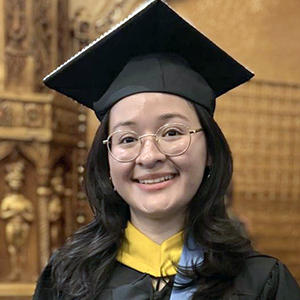
Norma Degante
Early Childhood General Education Advanced Standing Program (ECASP) '26
I’ve seen the impact on children who are experiencing so much stress at home. It’s a lot for a child to carry—and I understand how important it is that teachers have the tools to help children and families navigate these difficult times
Norma Degante was already doing the work of an educator long before she earned her master’s degree at Bank Street. As an assistant teacher at Children’s Big Apple in Jackson Heights, Queens, she spent her days supporting 3- to 5-year-olds through morning routines, outdoor play, and the everyday emotional challenges of early childhood. Alongside that role, she worked as a behavioral therapist, supporting children diagnosed with autism one on one through play-based sessions designed to help them build life skills, regulate their emotions, and find their footing in school and in the world.
Teaching was clearly her calling, and what she needed was a path to make it official—one that would allow her to stay in the classroom she already called home.
She found that path in Bank Street’s Early Childhood General Education Advanced Standing Program (ECASP). Designed for experienced educators already working in early childhood settings, the program allowed Norma to complete her master’s degree in just 16 months while continuing to work full time. She received six life experience credits for her years in the classroom, reducing both the cost and time of her degree, with a 50-percent scholarship covering the rest.
“Bank Street’s program felt right for me,” she said. “They offer scholarships, and I would be able to complete the degree in a shorter period of time.”
Word of mouth brought her to Bank Street’s door. Colleagues who had gone through the program spoke warmly about the close attention and community they had found there, and Norma was looking for exactly that. As part of a cohort of six students, she received individualized advising on coursework, scheduling, and anything else that came up.
“Here I received the close attention and community I was looking for,” she said. “As part of a small cohort, I was able to get the advisement and learning experiences that really supported my growth.”
Her fieldwork unfolded in a setting she already knew well: her own classroom. She also spent time in a 4-year-old room, an experience that sharpened her understanding of child development in ways she hadn’t anticipated.
“There’s a big difference between 3s and 4s,” she said. “The teacher in that room became an invaluable model as I learned about child development and teaching techniques.”
For her Integrative Master’s Project, Norma turned toward a question she couldn’t set aside. Her project, The Role of Early Childhood Educators in Supporting Social-Emotional Development and Cultural Identity of Latinx Children from Immigrant Families, examined how ICE enforcement actions affect young children and their families in communities like her own. Her advisor, Carmen Colón, helped her think through the research and see it to completion.
“I chose this topic because I know the value of culturally responsive practice, especially for communities with many immigrant families like where I live and work,” she said. “I’ve had students come to school crying because of the stress their family feels. Some families have been afraid to leave their homes, even to go to work. I’ve seen the impact on children who are experiencing deportations in their families. It’s a lot for a child to handle—and I understand how important it is that teachers have the tools to help children and families during these difficult times.”
Her conference group became an anchor throughout the program. When she was preparing a demo lesson on the water cycle, her peers stepped in with ideas about lessons they had taught. On the day of the observation, the students were engaged and excited, and the lesson was a success.
“It’s so important to have support,” she said. “I had ideas but I wasn’t sure which direction to take. I brought my thoughts to the conference group, they pitched in, and it really helped me work it through.”
Bank Street’s philosophy showed up in the small moments as much as the large ones. A professor pausing at the start of class to check in created space for students to say what they were carrying before diving into the work. That small ritual left a lasting impression on Norma.
“When we would come together for classes, sometimes we were tired or stressed, and our professor would take a moment to ask about how we were doing. It gave us the time and space to decompress,” she said. “It’s amazing what that small gesture can do. It’s something I now do regularly at my own school, just check in.”
Now a graduate, Norma is pursuing a head teacher position with the support of the program director and Bank Street’s Career Services team. She plans to stay connected through alumni events and continuing education workshops. She formed deep bonds and friendships throughout the program, and she knows her cohort will remain a touchpoint for future career growth.
“I believe in educational equity, and Bank Street’s pedagogy and philosophy is what drew me to the school,” she said. “Children need multicultural learning environments that respect and support every one of them—their cultural backgrounds and their individual learning needs. Bank Street reinforced that in me. It helped me develop into a better educator. It helped me grow as a person.”