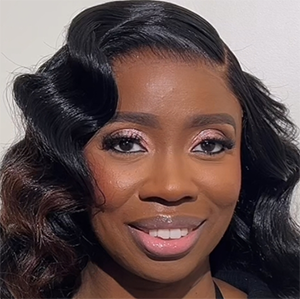
Kayonn Cleopatra Tanique McKoy-Clue
Early Childhood General Education Advanced Standing '26
I realized that the questions I was asking every day about my classroom were research questions—and that I had the tools to investigate them seriously.
Kayonn Cleopatra Tanique McKoy-Clue is a lead teacher at a NYC Public Schools UPK program in the Bronx, where her 3- to 5-year-old students come from a wide range of cultural and linguistic backgrounds. In May 2026, she earned her master’s degree through Bank Street’s Early Childhood General Education Advanced Standing Program, and she’s just getting started.
Her path to Bank Street wasn’t straightforward. When COVID-19 prompted her school to convert from a private elementary program to a NYC Public Schools UPK setting, Kayonn found herself in a new context with new demands. She had already been pursuing a master’s at another institution, but the Advanced Standing Program’s reduced course requirements, scholarship support that cut tuition by more than half, and the opportunity to earn up to six credits for her years of classroom experience made Bank Street the right fit at the right moment.
Kayonn was already working as a lead teacher, and the program was built for exactly that. She kept her classroom, deepened her practice, and brought what she was learning directly back to her students. In Xiana Foster’s course on reading, writing, and language arts, she found new ways to approach one of early childhood’s perennial challenges: keeping young readers engaged.
“I learned to make read-alouds more engaging by changing my tone, making connections, and enhancing guided observation by asking critical-thinking questions,” Kayonn said. “These strategies make learners more interested in reading and they prolong discussions, enabling students to express feelings, describe settings, and discuss how specific decisions affect their own lives from their individual perspectives.”
Bank Street’s cohort model gave Kayonn a community that pushed her thinking and held her accountable. In her conference group, she and her classmates brought videos of themselves teaching, sharing their written observations of individual children, and gave one another critical, respectful feedback—an approach that sharpened her self-reflection skills and her eye as both a writer and an observer of children. One idea in particular stayed with her, drawn from L. Todd Rose’s video “The Myth of Average.”
“The video explains that lessons should be differentiated because not all children learn the same way, so the teacher should plan to ensure learning is possible for all students. I remind myself about this often.”
Her final Integrative Master’s Project took her research instincts in a direction rooted in something she had observed in her classroom. Concerned by the behavioral and cognitive challenges she had noticed in children exposed to secondhand marijuana smoke, she designed a study examining how exposure to marijuana and edibles affects the development of children ages 3 to 5 in New York City. The work changed her understanding of what it means to be a researcher and opened a door she hadn’t anticipated.
“Working on my final project heightened my interest in producing research studies in the field of education,” Kayonn said. “I realized that the questions I was asking every dayabout my classroom were research questions—and that I had the tools to investigate them seriously.”
During her time at Bank Street, Kayonn faced significant hardship. She navigated a divorce and financial strain, all while teaching days, working nights, and raising her teenage son on her own. Even through the hardest stretches, she maintained the strong grades that her scholarships required and found consistent encouragement from the program’s director and her instructors.
She describes her Bank Street experience in three words: inclusive, supportive, collaborative, and she is taking those values with her.
“Today, I am successful because of Bank Street’s supportive community. The exposure to progressive theories and beliefs here has inspired me pursue becoming an educational leader as a way to share my knowledge and zeal and to ensure students participate in their own learning.”
Kayonn is now pursuing a PhD in Educational Leadership and Innovation at NYU, with her sights set on a director or assistant principal role where she can sit with teachers, combine ideas, and build the kind of student-centered, progressive learning environment that first brought her to Bank Street.